Choosing among the Best USB Power Strip Manufacturers in China? requires more than comparing prices or counting ports. A polished product photo cannot reveal loose sockets, unstable charging, thin internal wiring, or weak quality control. Buyers need to assess the manufacturer behind the casing. That means checking product specifications, factory capabilities, sample consistency, and the evidence supporting safety and performance claims.
USB-IF executive Jeff Ravencraft has emphasized USB interoperability. A practical paraphrase of that principle is: “A familiar port is not proof of reliable performance.” It is a useful reminder when evaluating a USB Power Strip. Ask whether USB-A and USB-C outputs deliver the stated power under realistic loads. Check how the manufacturer handles heat, overload protection, component sourcing, and production testing. Request clear documentation, not just a catalog page. Details matter.
Look closely. A sample that charges one phone well may behave differently with several devices connected. Compare labeling, cable length, socket spacing, packaging, and inspection records. Ask how defects are tracked and corrected. A supplier’s response can be revealing. Not every factory will provide the same depth of evidence, and no single checklist removes all purchasing risk. This guide introduces Chinese manufacturers through practical comparison points, helping importers and brands identify suitable partners with fewer assumptions. Some information may still require direct verification. That is worth saying plainly.
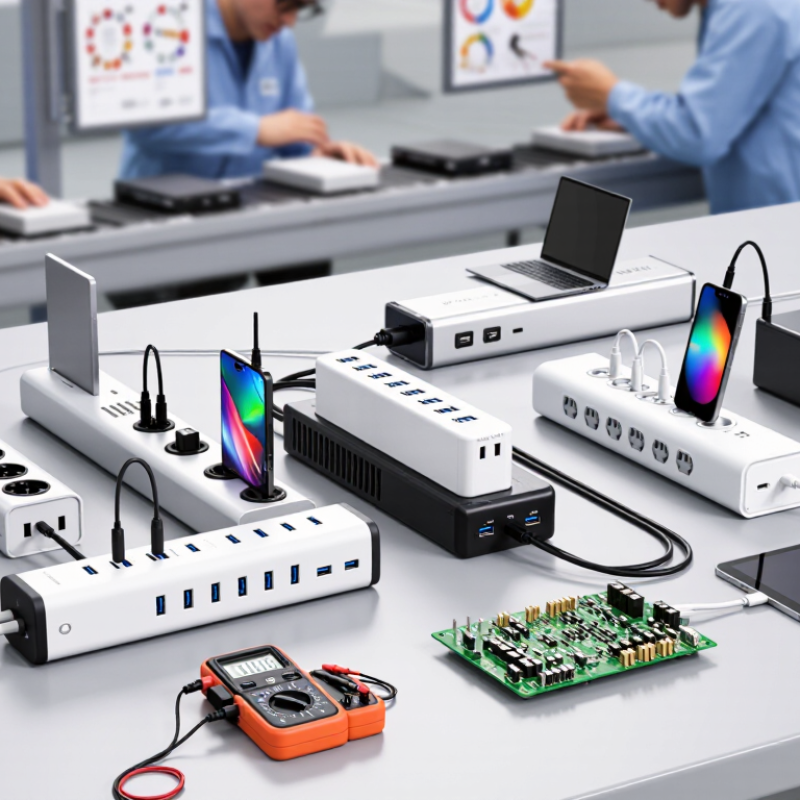
What Defines a USB Power Strip Manufacturer in China’s Electrical Supply Chain?
A USB power strip manufacturer in China is more than an assembly workshop. It connects product design, component sourcing, molding, wiring, testing, and shipment within an electrical supply chain. For buyers, that distinction matters. A reliable producer can explain how copper conductors, socket contacts, USB modules, and housing materials are selected and checked. Ask how production batches are traced, too.
Manufacturing capability shows in practical details. Can the team explain USB-A and USB-C output limits, overcurrent protection, grounding, and heat management in plain terms? Request test records for the exact model, not just a general company certificate. Review the plug, cable, and enclosure specifications against the requirements of your destination market. A sample should feel solid, with aligned sockets and no loose parts. Still, one good sample does not prove every production run will match it.
Tips: Ask for a factory audit, a sample inspection, and written quality checks at incoming, in-process, and final stages. Clarify who handles design changes and failed units. Small gaps in documentation can become real delays. Even experienced buyers sometimes miss them.
| Evaluation Dimension | What a Qualified Manufacturer Should Demonstrate | Evidence to Request | Why It Matters |
|---|---|---|---|
| Manufacturing Role | Clear responsibility for product design, assembly, inspection, and shipment. The supplier should distinguish its own production from outsourced processes. | Factory address, process flow, production-area records, and a written list of outsourced operations. | Helps buyers establish who controls production and who is accountable for product changes and quality issues. |
| Product and Electrical Design | Defined ratings for input voltage, current, total load, socket configuration, and USB output. Ratings should be consistent across the product, packaging, and technical documents. | Product specification sheet, wiring diagram, label artwork, and approved sample. | Electrical ratings and construction determine whether a product is suitable for its intended market and use. |
| USB Charging Performance | For each USB-A or USB-C port, the manufacturer should state supported output profiles and limits. For USB-C Power Delivery products, it should identify supported negotiated power profiles and total shared output limits. | Port-by-port output table, charging test results, and details of how output is shared when multiple ports are used. | USB connector type alone does not establish charging speed or supported power. Actual output depends on the design and connected device. |
| Safety and Market Compliance | Identification of the safety and regulatory requirements applicable to the finished product in each destination market. For China, the supplier should verify whether the product and its components fall within current compulsory certification requirements. | Applicable standards list, valid certificates where required, test reports matching the product model, and supporting component documentation. | Requirements vary by product construction and destination. A certificate for a component or a similar model may not establish compliance of the finished product. |
| Materials and Components | Controlled specifications for the enclosure, conductors, socket contacts, switches, USB charging module, and other safety-related components. | Bill of materials, component specifications, supplier records, and material declarations required for the destination market. | Component substitutions can affect electrical, thermal, and mechanical performance, so they should be reviewed and controlled. |
| Quality Control | Documented incoming, in-process, and final inspection procedures, with acceptance criteria appropriate to the product design. | Inspection plans, sample inspection records, functional test records, and procedures for handling nonconforming products. | A defined quality system makes production checks repeatable and helps identify defects before shipment. |
| Electrical and Functional Testing | Testing appropriate to the design, such as continuity, polarity, grounding where applicable, USB output, and checks for abnormal operation. | Test methods, calibrated-equipment records, batch test results, and traceable sample details. | Tests should correspond to the actual product configuration and its declared ratings; a generic report may not cover every model. |
| Thermal and Load Evaluation | Assessment of heating under specified operating conditions, including the rated load and USB charging load where relevant. | Test conditions, duration, measured results, and the product configuration tested. | Temperature rise depends on the design, materials, load, and operating conditions. Test details are needed to interpret results. |
| Traceability and Change Control | A method to identify production batches and review changes to materials, components, tooling, or electrical design. | Lot or date-code examples, change-notification procedure, and records linking products to inspection or test results. | Traceability supports investigation and containment if a quality or compliance issue is found after delivery. |
| Customization and Documentation | Ability to document agreed specifications for outlet layout, cable length, plug type, USB ports, labeling, packaging, and destination-market requirements. | Approved drawings, specification agreement, sample sign-off, and controlled packaging and label files. | Written approval reduces ambiguity between the requested configuration and the product ultimately manufactured. |
| Supply and Delivery Capability | Production planning based on confirmed specifications, component availability, order quantity, and inspection requirements. | Production schedule, capacity information relevant to the order, packaging details, and shipment inspection plan. | Delivery reliability depends on the particular order and supply conditions; capacity claims should be assessed against the requested configuration. |
| Responsible Supplier Assessment | Transparent answers about factory operations, subcontracting, product testing, and corrective actions, supported by records rather than marketing claims alone. | Factory audit findings, corrective-action records, and direct verification of key certificates and reports with their issuers where possible. | A document review and product-specific evaluation provide a more reliable basis for selection than a general supplier ranking. |
FAQS
It may manage design, component sourcing, molding, wiring, testing, and shipment. Ask how each production batch is traced.
Request test reports for the exact model, plug type, and internal components. General certificates may not show how your specific model performed.
No. Check socket alignment, cord strain relief, and enclosure finish on samples and production units. One sample is not enough.
Ask about overcurrent protection, grounding, conductor materials, and heat management. Request test conditions and relevant records.
Check each port’s output and the product’s total wattage. Ask how output changes when several devices charge together.
Request details from sustained-use testing, including the conditions and duration. “Fast charging” alone explains little.
Discuss custom ports, housing, packaging, minimum order quantities, and sample lead times. Get specification changes documented in writing.
Ask about factory audits and incoming, in-process, and final inspections. Clarify who handles design changes and failed units. I may be overcautious, but I would recheck the first production batch. Small details matter.
Conclusion
Choosing a reliable USB Power Strip manufacturer in China involves looking beyond product price. Manufacturers may design and assemble the complete unit or focus on components and contract production, so buyers should clarify each supplier’s role, production capacity, quality controls, and OEM support. For safety, ask how products are evaluated against applicable Chinese requirements, including GB/T 2099.7-2015, and request relevant factory certifications and product test reports. Documentation should match the exact model and configuration being offered.
Compare USB-C ports by their supported output and charging protocols rather than by connector type alone. USB Power Delivery capability varies, and a claimed 240 W PD 3.1 output should be supported by clear specifications, compatible components, and test evidence. A practical supplier review considers electrical safety, protection features, consistency between samples and production units, customization options, lead times, and after-sales communication. These checks help buyers assess whether a manufacturer can meet their intended market and product requirements.
