Choosing the best Surge Protector Power Strip is not just about finding the highest joule rating. The right choice depends on what you plan to protect, where the strip will sit, and whether its safety features are clearly documented. A desk setup with a laptop and monitor has different needs from a media center crowded with a television, console, and router. Small details matter.
The risks deserve perspective. The National Fire Protection Association’s report, Home Fires Involving Electrical Distribution or Lighting Equipment, estimates an annual average of 32,620 U.S. home fires involving this equipment from 2015 to 2019. Those fires caused an estimated 430 deaths and $1.3 billion in direct property damage each year. These figures are not surge-specific, so they should not be treated as proof that surge strips prevent fires. They do show why electrical product safety deserves careful attention.
A useful comparison starts with independent safety certification, such as UL 1449 listing, then checks joule rating, outlet spacing, cord length, and overload protection. Look for a protection indicator, too. It can show whether the surge-protection components remain active, though it does not guarantee protection against every event. No strip is perfect; that is worth admitting. This guide compares practical features and product claims, while separating verifiable specifications from marketing language. Use it to find a model suited to your devices, not simply the longest feature list.
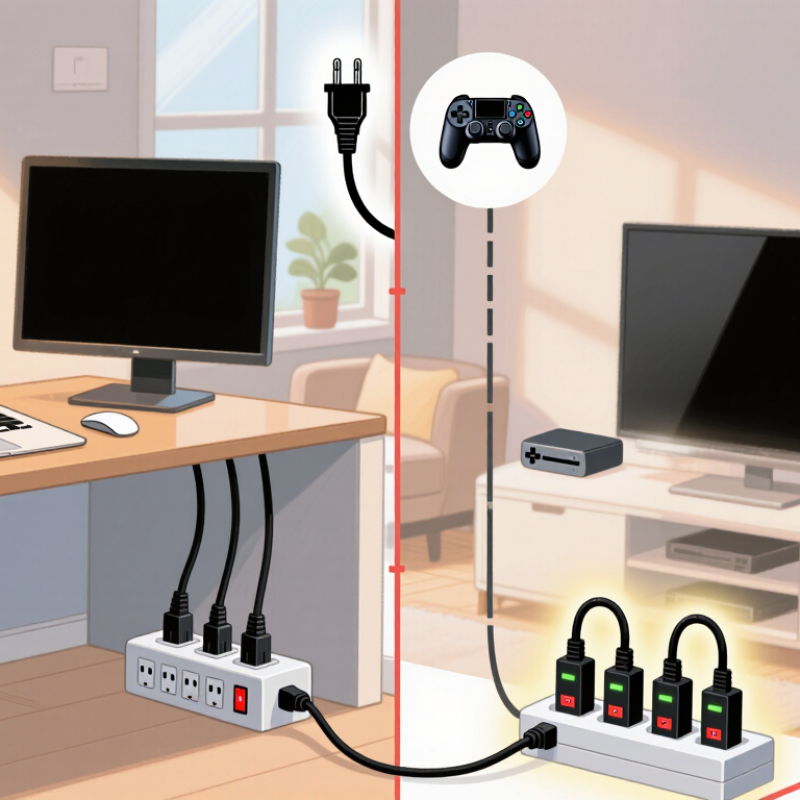
What Surge Protector Power Strips Do Under UL 1449’s Type 3 SPD Classification
Many plug-in power strips are Type 3 surge protective devices (SPDs), designed to limit transient voltage near connected equipment. UL 1449 classifies SPDs by installation role and tested performance, not by outlet count. Type 3 units are generally installed on the load side of service equipment, with about 10 m (30 ft) of conductor between them, unless specifically listed for closer placement. That distance supports coordination with upstream protection.
IEEE Std C62.41.2 describes a 6 kV/3 kA combination-wave benchmark for evaluating common surge environments. This is a laboratory test, not a promise that every household surge will be harmless. UL 1449 also uses a Voltage Protection Rating (VPR), which indicates let-through voltage under specified test conditions. A lower VPR can mean less voltage reaches connected equipment during that test. Conditions matter.
When comparing strips, check the VPR, electrical rating, and protection-status indicator, where provided. A joule rating alone does not establish how well a device limits voltage or meets safety requirements. No Type 3 strip stops every surge, especially severe lightning-related events. That matters. I admit, labels make comparison less tidy than it should be. These details reflect UL 1449 and IEEE Std C62.41.2.
FAQS
It limits transient voltage near connected equipment. It cannot stop every surge, especially severe lightning-related events. Conditions matter.
It is generally placed on the load side of service equipment, with about 30 feet of conductor between them. Some devices are listed for closer placement. This spacing supports coordination with upstream protection.
It shows let-through voltage under specified test conditions. A lower rating can mean less voltage reaches equipment during that test. It is not a guarantee.
No. Check the VPR, electrical ratings, and protection-status indicator, if provided. A joule number tells only part of the story.
A 120-volt, 15-amp circuit has a ceiling of 1,800 volt-amperes. That roughly equals 1,800 watts when power factor is near one. The label is easy to overread.
For loads running at least three hours, sizing guidance generally uses 125% of the load. That points to 12 amps, or about 1,440 watts, on a 120-volt circuit. It is not a guarantee.
Check its marked amperage and wattage, grounded outlets, cord rating, and plug spacing. Confirm that surge protection is identified; a general power-tap safety listing alone does not prove it. Keep the strip uncovered and away from rugs.
Replace it if its protection indicator goes dark, even if outlets still work. Watch for a warm plug or a heater sharing the circuit. Small details count.
Conclusion
A Surge Protector Power Strip is designed to help protect connected electronics from voltage surges, and many models fall under UL 1449’s Type 3 surge protective device classification. Its voltage protection rating indicates the level at which excess voltage may pass through to equipment; a lower rating generally means less let-through voltage. Comparing this figure alongside the product’s safety listing can help clarify what protection it offers.
A typical 120 V, 15 A circuit has a maximum capacity of about 1,800 W, so the combined load of connected devices should stay within the circuit’s limits. Surge waveforms described in IEEE C62.41.1 provide useful context for evaluating the kinds of electrical events protection may need to address. When choosing a strip, consider verified listing information, the number and spacing of outlets, cord length and condition, and indicators that show whether protection or grounding is active.